The great music scanning
Lions have possessed the means for a somewhat automated scanning of all the paper books in the apartment & most of the remaneing paper documents. The mane risk has always been the high rate of data loss. It would entail storing the documents on 2 hard drives or possibly cloud storage.
This is the next requirement in creating enough room to store the VCR.
Much of the paper is probably on archive.org already. It only exists as a record of what titles lions had. The childhood books were manely lost because there was no record of their titles.
Sheet music magazine was never scanned by anyone & was probably not old enough to be public domane. There are only fleebay print issues. The compute magazines from the 80's are long gone, but already exist in some scanned format. It would take a full tripod setup to scan the hundreds of unscanned pages in the apartment. Since they would be discarded, it would be easiest to cut out the pages for scanning.
The glued bindings were all torn apart, 30 pages at a time. The stapled bindings eventually had the staples taken out & then were cut down the middle.


The setup ended up heavily using the foot pedal, on-camera flash, & wide lens. The foot pedal did quite well in the purpose for which it was built, decades earlier.
The wide lens reduced the glare on glossy paper, but glossy paper was still problematic. After much time with different bounce patterns, angling the paper, it was decided these magazines weren't precious enough to eliminate the glare. Completely eliminating glare would entail a big glass cover & 2 angled lights.
Eventually discovered the best glare reduction came from a 90 deg bounce flash, bouncing off a white card. This was a pain to do, so lions only did it for the most problematic pages.
Another problem was sunlight.

It's not possible to convert it to 1 bit, but lions didn't care enough about these scores to close the window & control the lighting. Somewhat acceptable results are possible with edge detection, but when combined with the need to split into pages & crop, it's going to be easiest to invest in a better monitor.
3 hours of semi automatic shooting & page turning, being careful not to skip any pages, got all the sheet music magazines scanned into 576 images in 5GB. They were mostly in page order but not date order. They were all in the same orientation.
Then it was into the video editor as a JPEGLIST file, 1 fps. Fortunately, most pages had numbers & all the issues were similar length, which aided navigation. Rather than transcoding, the original images were just organized in an EDL.

Cinelerra didn't lose any pages sorting all the issues at 1fps. It might have problems at 29.97. Some issues were lost to time.
Cinelerra picked up all the extra lines of the JPEGLIST. At this point, lions discovered nedit renders 1 extra newline after the end while vi properly ends the document at the last newline, after 30 years of using nedit, but Cinelerra shouldn't pick up empty lines.

As lions changed teachers, the magazines switched from popular music oriented sheet music magazine, piano stylist, to keyboard classics.

The internet considers it sacrilegious to cut books apart for scanning, but they're never going to be read again. The burial act for print media is to cut it apart for scanning. Some of them came from teachers who are no longer with us. It's the last time lions would ever see 12.25x9.5 paper. Lions would never read most of the scanned text, but there was some archival value for texts which are irreplaceable, someone else might find a use for them, & what was the point of storing the printed media if there was no desire to have it around.
What about just buying new digitized versions of the original books? They wouldn't be bought until there was a need & the need wouldn't happen as easily as if they were already around.
They're 1 of a kind editions & they're curated collections of recommended pieces rather than the complete opuses. Anthologies are useful for manetaining sight reading. The editions in IMSLP are pretty bad compared to what lions remembered reading long ago. The Alfred prefaces were entertaining when lions read those long ago. No-one reads from cover to cover anymore. There's too much information now.
Lions were amazed by the amount of music text the old man bought in the late 80's but they represent a time when you couldn't download a random piece on demand. You had to have massive libraries of every piece ever written, just to get the 1 piece.
To browse through the digitized books like young lion did, it's not practical to convert so much text to the reader's current format. The reader would need better displays or at least greyscale support. It might be possible by individually greyscaling the RGB channels. The reader currently only supports 1 bit per RGB channel. It would have to go to the native 16 bit color.
There needs to be a smarter parser which splits each image into 2 pages, by blobbing the black areas. It might just be time to upgrade to a 4k monitor.
Eventually converged on keeping all the original images, transcoding to video & backing them up on some kind of burner gootube account, then keeping the video files locally.
---------------------------------------------------------------------------------------------------
More time was spent organizing scans & selecting what to scan than actually scanning.
Magazines & Alfred texts were easy decisions to scan. All the beginner scores are under copyright & not online.
All the Alfred texts are still under copyright & still being sold on alfred.com. They're easier to read than the ancient printings on IMSLP & irreplaceable.
All the edition Peters texts are under copyright but some form of the original scores are all on IMSLP. Some IMSLP copies are exact replicas through other publishers & some are lower quality engravings of the same scores. The lower quality ones got scanned. The key factor is a reasonably equivalent form.
Other anthologies were not on IMSLP but all the contained scores were. Some were gifts. Lions believe if anyone knew their gift was now online, they would say don't bother scanning it & don't bother keeping the printed books. So gifts had a lower chance of being scanned than books lions paid for.
https://archive.org/details/welltemperedclav0000bach
Bach well tempered clavier, Dover edition is on archive.org in better quality than lions could scan. Only prelude & fugue #2 had notes from a teacher. Lions learned some others twice, but completely forgot. Only paperclips bear witness to the past. The decision was made to scan just the pieces with teacher annotations & put them in the annotations directory.
Kicking off the Schirmer books with 59 piano solos you like to play, it became clear that these were all exact copies of schirmer scores on IMSLP. Scanned them anyway, even though the table of contents might have been enough. From this point on, anything which could be downloaded in a reasonably equivalent form was not scanned. The equivalent PDFs were downloaded to /home/music when it was more convenient than scanning.
The complete Beethoven sonatas, Schirmer edition are on IMSLP.
The complete Hanon book is on IMSLP.
https://imslp.org/wiki/Sonatinen-Album_(K%C3%B6hler,_Louis)
Sonatina album, Kohler edition is an exact reprint of the Peters edition sonatina album on IMSLP.
https://imslp.org/wiki/Sonaten_f%C3%BCr_Klavier_zu_zwei_H%C3%A4nden_(Haydn,_Joseph)
Complete Haydn sonatas, Martienssen edition are individual downloads on IMSLP.
https://imslp.org/wiki/Complete_Works_for_the_Piano,_1915_(Chopin,_Fr%C3%A9d%C3%A9ric)
Chopin Album, Joseffy edition is on IMSLP in various compilations. All of Joseffy's editions are there.
Chopin Preludes, Scholtz edition is on IMSLP but in a more condensed engraving than the edition Peters so it was scanned.
Bach english suites urtext, edition Peters was not online so it was scanned.
https://imslp.org/wiki/Special:ImagefromIndex/105588/hfpn
Rach Chopin variations are on IMSLP in only french, so it was scanned.
Rach Moments Musicaux, Isidor Philipp edition are not online.
Bach 2 part inventions, Heath edition are not online.
Xeroxed scores were manely discarded. Among xeroxed scores to be discarded were many pieces lions either started learning & abandoned or completely forgot about learning. Beethoven Op 2 No 3, Schumann Fantasy, Liszt Heroischer Marsch, Scriabin prelude 5, La Campanella, Brahms fugue on a theme by Handel, Taunhauser overture, Rach 3 cadenza, Joplin Elite Syncopations were not scanned.
Only scanned the bits of Scherzo & Marsch & Rhapsody fit for a
saint which lions altered, hoping to be able to place the sections by
ear, if the need ever arose. It seems most of the rhapsody was
rewritten.
There was a teacher note about the International library of piano music being the bible for Scarlotti. The 1977 edition, volume 1, gifted was not online, but
https://archive.org/details/internationallib0001unse_p3m2
Archive.org had the 1967 edition. Verified the table of contents was exactly the same as the 1977 edition & scrapped it.
The lion kingdom had the 1960 Presser edition of the 332 page Mozart sonatas & fantasies, edited by Nathan Broder, with numbered measures & teacher annotations for K.330. Archive.org had the 1996 edition from Dover, but pages 237-250 were missing & it didn't have the fantasies. That's 332 irreplaceable pages.
There was a Chinese translation of the 89 page Debussy preludes, book 2. The lion kingdom already scanned a Russian translation of the Scriabin preludes & a russian Schubert anthology. IMSLP has several editions of the complete Debussy preludes. There was some sentimental value in having the Russian books. It makes you ponder what you're ever going to look at again & think about mortality.
https://archive.org/details/isbn_0825613108
Schirmer's pocket manual of musical terms is on archive.org
After 5 days of continuously scanning & organizing, lions were thankful there wasn't any more music text. The John Thompson beginner books were lost. In terms of remaneing paper in the apartment, there were a few more cases of random notebooks, magazines, & financial texts. It's not practical to scan every single thing a lion ever wrote. They're never going to be viewed again.

All printed music either scanned or found online.
---------------------------------------------------------------------------------------------------------------------
In the last 20 years, Die Hard gained a reputation is 1 of the greatest xmas movies ever made, if not the greatest. While it came across as nothing more than another 80's cop show in syndication, a 2nd rewatching in HD was more impressive & confirmed it was an xmas movie.


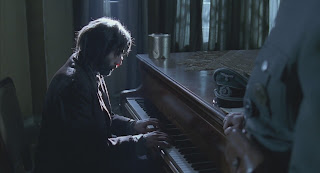
The many twists & turns, over the top characters, suspense, & the legendary Alan Rickman really popped. Indeed, Harry Potter & Die Hard were his biggest roles.
Characters like that just can't be written anymore. The new must all be bland dilutions of the minimum possible prompts for AI to reconstitute what has already been done.
-----------------------------------------------------------------------------------------------------

Huge effort, once again playing a game of finding out how far a lion can go with the robot at 8 minutes. Hit the wall at mile 18. Cramping started after mile 18, probably from glucose depletion. Had just snickers bars & gatorade. There are signs of interval training benefiting these long efforts. That got the year up to 3075.


Lunch rush on the super highway.


Comments
Post a Comment